
Many food companies invest time and money to implement ISO 22000, FSSC 22000, BRCGS or HACCP. But the real challenge is not getting the certificate — it is maintaining the system daily.
In reality, most food safety failures happen not because the standard is wrong, but because simple things are not done correctly on the shop floor.
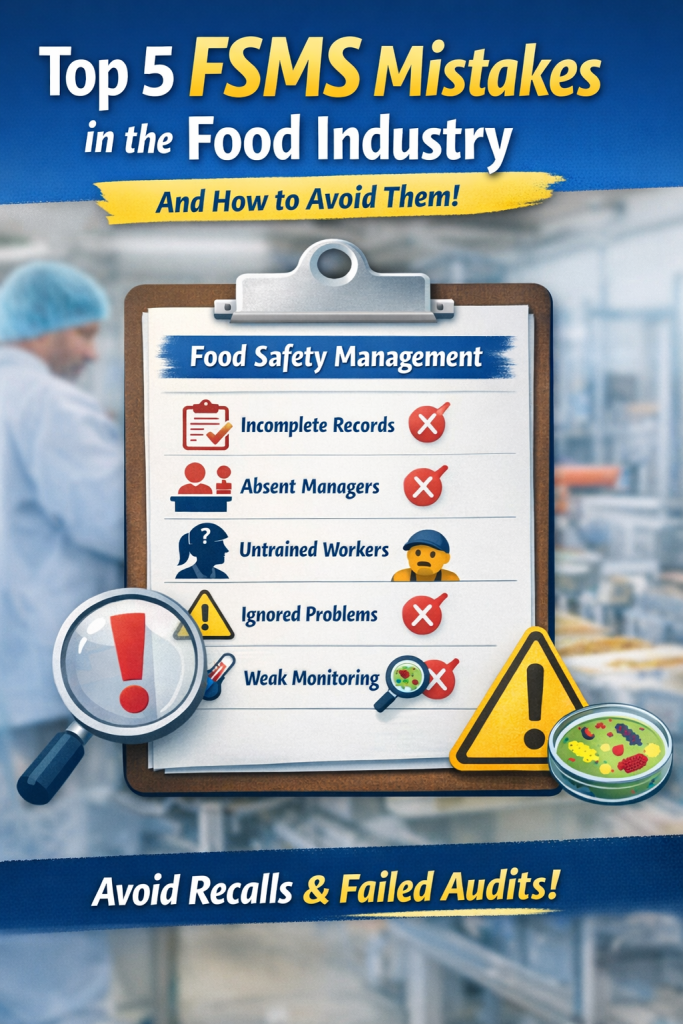
Here are the top 5 practical errors we commonly see in food factories and how food safety professionals can control them.
1. Records Are Filled Just for the Sake of Audit
Temperature logs, cleaning records, CCP monitoring sheets and calibration records are sometimes completed later, guessed, or even copied from previous days.
Why this is dangerous:
If records are not real, you lose control over food safety. In a complaint or recall situation, there is no evidence to prove product safety.
What to do:
-
Fill records in real time
-
Train operators on why each record is critical
-
Supervisors must verify daily, not monthly
2. Management Is Not Truly Involved
Top management often believes food safety is only the QA department’s responsibility.
Why this is dangerous:
Without management support, there will be no resources, no authority, and no food safety culture.
What to do:
-
Management must attend food safety meetings
-
Review KPIs, complaints, audit results
-
Show leadership in GMP and hygiene compliance
3. Workers Follow Rules Without Understanding
Employees wash hands, wear gloves, and follow CCP limits — but they don’t know why.
Why this is dangerous:
When pressure comes, people break rules they don’t understand.
What to do:
-
Use simple, practical training
-
Explain contamination risks with real examples
-
Repeat awareness regularly, not only once a year
4. Problems Are Closed on Paper Only
Internal audit findings and non-conformities are closed in documents, but root causes remain.
Why this is dangerous:
The same issue appears again in the next audit or during a customer inspection.
What to do:
-
Do real root cause analysis
-
Fix systems, not symptoms
-
Verify effectiveness, not just close NCRs
5. Critical Controls Are Not Monitored Properly
Chiller temperatures, metal detectors, sieves, sanitation, pest control and allergen controls are sometimes checked irregularly.
Why this is dangerous:
Failure of one CCP or OPRP can directly cause unsafe food reaching the consumer.
What to do:
-
Monitor every shift
-
Validate and verify controls
-
Review trends, not just single readings
Final Message to Food Safety Professionals
A Food Safety Management System is not a file system.
It is a living system on the factory floor.
If these five areas are controlled properly, you will:
-
Reduce audit non-conformities
-
Prevent product recalls
-
Build a strong food safety culture
-
Gain customer and regulatory trust