
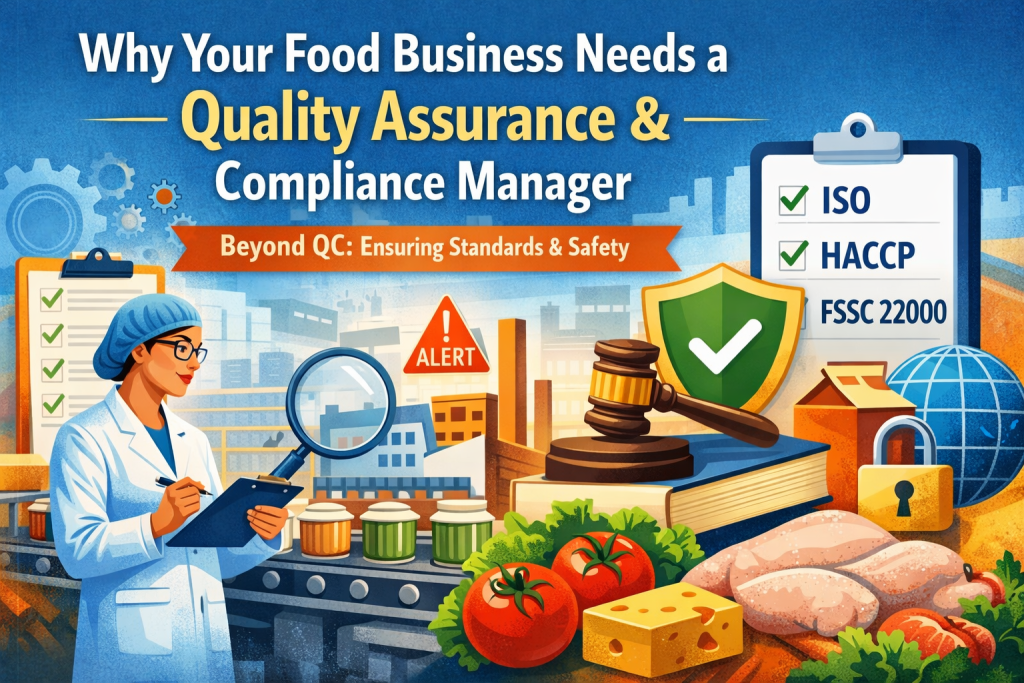
In many food manufacturing and processing companies, the Quality Control (QC) team is the backbone of daily production checks. They test raw materials, monitor processes, inspect finished products, and release batches. However, a growing number of businesses are struggling to maintain international standards and regulatory compliance because they rely only on QC — without a dedicated Quality Assurance (QA) and Compliance function.
This gap is not just a technical issue. It is a business risk.
QC vs QA: Understanding the Critical Difference
Quality Control focuses on detecting problems.
Quality Assurance focuses on preventing problems.
QC answers the question:
“Is this product within specification today?”
QA answers the bigger questions:
“Is our entire system capable of consistently meeting legal, customer, and certification requirements tomorrow and next year?”
Without a qualified person responsible for Quality Assurance and Compliance, companies often face:
-
Repeated non-conformities in audits
-
Weak documentation control
-
Poor risk assessments and HACCP reviews
-
Incomplete legal compliance registers
-
Ineffective corrective and preventive actions (CAPA)
-
Loss of certification or downgraded audit grades
-
Increased customer complaints and recalls
Why a Dedicated Compliance Role Is No Longer Optional
Modern food safety standards such as ISO 22000, FSSC 22000, BRCGS, IFS, GMP, and HACCP are system-based. They demand continuous monitoring, verification, validation, and improvement — not just end-product testing.
A trained QA & Compliance Manager is responsible for:
-
Maintaining the Food Safety Management System (FSMS)
-
Ensuring compliance with local regulations and export market laws
-
Managing internal audits and certification audits
-
Reviewing HACCP, risk assessments, and food defense/fraud plans
-
Controlling documents, records, and change management
-
Training employees and building food safety culture
-
Coordinating with regulatory authorities and certification bodies
QC alone cannot carry this strategic responsibility while also running routine laboratory and line inspections.
Business Impact of Ignoring Compliance Leadership
Companies that operate without a proper compliance owner often experience:
-
Audit stress and last-minute document preparation
-
Delays in certification and customer approvals
-
Rejection by international buyers
-
Higher operational costs due to rework and wastage
-
Damage to brand reputation and trust
In contrast, organizations with a dedicated QA & Compliance professional enjoy:
-
Smooth certification audits
-
Strong regulatory confidence
-
Faster market access
-
Reduced risk of recalls and legal penalties
-
Sustainable compliance, not temporary fixes
Conclusion: Compliance Is a System, Not a Side Job
Quality compliance cannot be treated as a part-time responsibility added to a QC officer’s workload. It requires focused leadership, technical competence, and system thinking.
Appointing a dedicated Quality Assurance & Compliance Manager is not an expense — it is an investment in:
-
Food safety
-
Legal protection
-
Brand credibility
-
Export readiness
-
Long-term business growth
In today’s competitive and highly regulated food industry, maintaining standards without a compliance champion is like running a factory without a safety officer. It may work for a while — until one audit, one incident, or one customer complaint exposes the risk.